■INAWASHIRO
■OKINAJIMA
■AZUMA
■SKY LINE
■CHISATO
■TSUKIWA
■NAGASE
■MOUNTAIN
 CLIMBING & HIKING
■FLOWER
■SKI AREAS
■HISTORY

■MAP
AIZU WIDE AREA
INAWASHIRO AREA
 (Center of a Town)
  (Front of Station)
OKINAJIMA AREA
AZUMA AREA
SKY LINE AREA
CHISATO AREA
TSUKIWA AREA
NAGASE AREA
SKI AREAS

■ACCSESS

Top>Inawashiro area
■Kamegajo Castle site Park
(Historic site designated by the town)
Kamegajo Caslte, built on a hillock at the foot of Mt. Bandai, was the residence of Inawashiro famly that ruled this region in the medieval ages. Inawashiro clan wanted to be independent and frequently fought with a feudal lord Ashina in Aizu Wakamatsu. The father and the son of Inawashiro family even fought against each other siding with different parties in the battle between Masamune Date and Yoshihiro Ashina,. Later in the Edo Era, a deputy governor was posted in the castle and it remained a strategic point for the east Aizu region during the time of the Tokugawa Shogunate. However, the castle was burned down in the Boshin Civil War. With a hope to restore the site, some public-spirited men of the locality, initiated by Sukeji Kobayashi and his son Saiji, planted cherries and azaleas at their own expense. They also built a rest house and Kangetsu bridge to remodel it into a park. The park, now called Oshiroyama Park, is popular as a place for relaxation and refreshment.

■Former residence of the Yamauchis’
(Important cultural asset of the town)
The thatch-roofed house was built in 1811 (the 8th year of Bunka in the Edo Era)
The farmhouse is presumed to be a residence of a family of government official class. The house was moved from Sunagawa district to the present site in 1972 (the 47th year of the Showa Era). At the time of reconstruction some alterations were made in consideration of heavy snowfall. In the annual event “the Procession of Oshin’s Wedding” it is much photographed as a model for a bride’s house.

■An-nonji temple
The old Sodo-shu sect temple was built in 1601 and is also called Kairakuzan after the hill on which the temple sits. The principle image of the temple Amida Nyorai, a bronze statue, is designated a national important work of art.

■Ju-hakken-gura(old brewery)
The twenty-ken (about 36m) long log, cut down in Mt. Miya for a girder at the time of construction, was unwillingly shortened by two-ken (about 3.6m) because it was too long to turn around the corner to be carried into the site. Thus, the name which means eighteen-ken brewery.

■Tenshi zelkova
Measuring fifteen meters around the trunk, the tree is certified to be the largest zelkova in Japan by the Environment Agency.

■Inagawa Sake Brewery
Inagawa is the only brewery that makes sake from the local rice and water. Passing by the old brewery house makes you feel as if you were back in the Meiji Era.

■Old wooden fence of Sato dental office
Old wooden fence runs along an old alley, which reminds us of the old Meiji Era days. The fence remains well with care.

■Hanitsu Jinja shrine
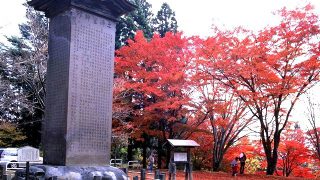
The shrine is dedicated to Masayuki Hoshina, the Aizu Han founder. It was built upon his death in December 1672 (the 12th year of the Kanbun in Edo Era) by his will. The original shrine is said to have been no less luxurious than Toshogu shrine in Nikko. Regrettably it was burnt down in the Boshin Civil War. After that, the object of worship took refuge in Tonan in the Shimokita Peninsula in Aomori-Ken. It returned to Inawashiro at the time of the reconstruction of Hanitsu Shrine, and the new house was built in 1880 (the 13th year of the Meiji Era.) The shrine is designated national historic site. The 7.3 meter long and thirty ton stone monument is the largest in Japan and the epitaph written by Ansai Yamazaki praises Masayuki’s merits.

■Tomb of Masayuki Hoshina, the founder of Aizu Han
(National Historical Monument)
Masayuki was born as the fourth son of Hidetada Tokugawa, the second shogun of the Tokugawa. He was appointed the liege of Aizu Han after his services in Shinshu Takato Han and Dewa Mogami Han. He moved to Aizu the year before his death, and ordered his burial in the land at the foot of Mt. Bandai where the view of The Lake Inawashiro stretches. The stone-paved path in the cedar woods to the right leads to the innermost shrine where his tomb stands.

■Iwahashi Jinja shrine
The Iwahashi shrine is presumed to be the oldest in this area judging from the oldest local record, about 1200 years old, which says “I hereby confer the lower class of the junior grade of the fourth rank to this shrine.” After several ups and downs, the shrine received a visit by the lord Hoshina Masayuki. With a wish to be buried in the land, he had a ritual to have Hanitsu ordained as subordinate shrine to Iwahashi shrine. At his death Hantsu shrine was dedicated to his spirit in conformity with his will.

■Ohshika-zakura cherry tree
(Precious natural product designated by the town)
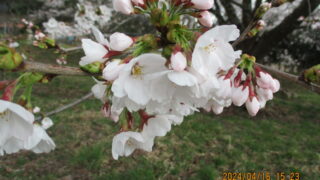
One of the Five Notable Cherries in Aizu, Ohshika-zakura, meaning Big Deer Cherry, stands in the precincts of Iwahashi shrine, to the left of the main building. The color of the blossoms, resembling that of deer, the tree is said to have been so named. The tree was brought from Kyoto by an imperial envoy when he made a visit to the shrine during the reign of Emperor Murakami (AD947 - 957), and was planted at that time. The blossoms come into full bloom at the beginning of May.

■Bandai Inawashiro Hayama Hot Spring
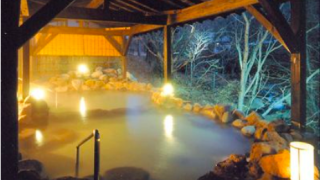
Among many hot springs in Inawashiro, the ones around Mt. Bandai contain salt while the ones in Numajiri or Nakanosawa at the foot of Mr. Adatara are sulfur springs. The hot spring led from the 72.2 degrees C. fountain head is categorized in sodium chloride hot spring. It has characteristic effects on the cure of a cut, a burn, chronic dermatitis, physical weakness and women’s diseases as well as general effects on neuralgia, muscular aches, sensitiveness to cold, hemorrhoids, and digestive troubles. The hot mineral water gushing near the Inawashiro Ski Area is supplied to the nearby hotels, inns and pension (western-style tourist homes) as well as minshuku (Japanese-style tourist homes), and this has altered the ski resort to an all-season resort.

Effective for: Digestive diseases, neuralgia, and rheumatism
Accommodation: 6 hotels/inns 2 minshuku 2 pension
Access: 10 min. drive from Inawashiro-Bandai Kogen I.C. on the Ban-etsu expressway
Phone: (0242)62-3200 Bandai-Inawashiro Hayama Onsen-Kumiai (inn-keepers’ association)

■Biwa-sawa Shinrin Koen
A few minutes drive from Mineno Oh-ishi (volcanic rock) up Mt. Bandai brings you to the quiet camp site in the larch woods. The site has a tennis court, playground, promenade and meeting room. The administration building is available for lodging. There is rental for tent, cabin and necessary camping gear.

■Kawakami Hot Spring
The hot spring is located halfway between Inawashiro and the Bandai Highlands. There is a so-called Pension-mura, a community of small western style guest houses, and some inns in the area. Within 15 minutes drive to Goshiki-Numa Swamp area and the Lake Hibara, the hot spring is conveniently located. Since the temperature of the hot spring water from Mt. Bandai is comparatively low, you can take a deep and long bath to get your body warm through and through.

Effective for: Diseases of the digestive system, eye diseases, and neurasthenia
Accommodation: 3 inns, 5 minshuku
Access: 25 min. drive from the Bandai-Kogen I.C. on the Ban-etsu expressway, or a few minutes walk from Kawakami Onsen bus stop off the bus for Bandai Kogen
Phone: (0241)32-2130

■Mine-no Oh-ishi
(Mine volcanic rock)
At the time of Mt. Bandai’s great eruption in 1888 (the 21st year of the Meiji Era), volcanic mud flow carried a huge rock of andesite to the present site in Mine. It is 8.2 meter wide and 3 meters high. The fact that the energy of a volcanic mud flow was so great that such a huge rock was carried 5 kilometers down the slope is academically precious. (The rock was designated as the Nation’s Natural Monument in 1941.)

Mine-no Oh-ishi walking course:
Inawashiro Kominkan (community hall)…(0.2km)…Kamegajo castle site gate …(0.6km)…Saienji temple…(1.6km)…Mine-no Oh-ichi…(2.0km)…Mine-no Fudo-taki waterfall…(1.0km)…Tsuchida-zeki (entrance to Mine)…(1.4km)…Iwahashi Jinja shrine…(0.3km)…Tanaka Masaharu’s tomb…(0.3km)…Hattori Ankyu’ tomb…(1.5km)…Inawashiro Kominkan (toatal 8.9km)

■Tomb of Tanaka Masaharu
Tanaka served the lord as principal retainer for 34 years and later assumed the post of deputy governor of the castle for 5 years contributing to solidify Aizu Han.

■Tomb of Hattori Anky
Hattori Ankyu was a grand son of Ranmaru Mori, page to Oda Nobunaga. He worked under Hoshina Masayuki, the founder of Aizu Han. He studied Shinto thoroughly by order of his master and became the first priest at Hanitsu Jinja shrine.

Bandai Panorama walking course
Bandai Kokuritsu Seinen-no Ie (National Bandai Youth Training Center)…(2.2km)…Hanitsu Jinja…(0.6km)…Iwahashi Jinja…(0.7km)…Saienji temple…(0.8km)…Inawashiro Kominkan…(0.2km)…Inawashiro Town Office…(2.5km)…Entrance to Midorino Mura and Tenkyoudai intersection on Route 7…(0.6km)…Midorino Mura…(1.7km)…Choei Bokuji (Town pasture)…(0.8km)…Tenkyoudai…(3.5km)…Bandai Kokuritsu Seinen-no Ie (total 12.7km)

■Uwanetsugi-no Kobushi
300-year-old kobus magnolia. Kobus magnolia trees have been regarded useful for forecasting the harvest. At the foot of the tree are nine monuments of Bato Kan-non (Buddhist deity of mercy which has a human body with the head of a horse) which are designated by the town as a natural monument.

■Gorinto stone monument
(fImportant cultural asset of the town)
This five-storied pagoda is said to have been erected in 1658 by Hiraemon Usui in Domeki village with the help of people in Inawashiro to the illustrious memory of Shimousanokami Moritane, the 14th lord of Inawashiro Castle.

----------------------------------------------------------------------------------------------------------------
100 Shirominami, Inawashiro-machi, Yama-gun, Fukushima-Ken 969-3192Phone: 0242-62-2117 Fax: 0242-62-5175c/o Inawashiro Town Office, Commerce, Industry,
and Tourism SectionInawashiro Tourism Promotion Planning Committ
ee