■INAWASHIRO
■OKINAJIMA
■AZUMA
■SKY LINE
■CHISATO
■TSUKIWA
■NAGASE
■MOUNTAIN
 CLIMBING & HIKING
■FLOWER
■SKI AREAS
■HISTORY

■MAP
AIZU WIDE AREA
INAWASHIRO AREA
 (Center of a Town)
  (Front of Station)
OKINAJIMA AREA
AZUMA AREA
SKY LINE AREA
CHISATO AREA
TSUKIWA AREA
NAGASE AREA
SKI AREAS

■ACCSESS

Top>Azuma area
■Numajiri Mine・Mt. Numajiri
The area once on the border between Aizu and Nihonmatsu, there were constant struggles for mining right and the right for the use of hot spring water. During the Genroku Era around 1688 in Edo Period, sulfur was valued as gun powder material as well as spill. With rich resources Mt. Numajiri was literally a mountain of treasures. When Mozaemon Endo in Shirakijo Village in Aizu set about digging sulfur, he marked the territorial boundary with charcoal buried along the border. Against the marking, the Nihonmatsu side secretly buried charcoal across the border in the land under which hot spring vein was. With the two sides opposed over the rights, the disputes never ended. In order to settle the dispute, Tokugawa Shogunate examined the drawings from both sides, and turned down Nihonmatsu’ declaration as untrustworthy. It was concluded that the boundary between Aizu and Nihonmatsu lied on the ridgeline of Mt. Tessan through Mt. Adatara.
Numajiri Sulfur Mine revived in Meiji Era when private capital was invested. It had about 200 workers with an annual output of 17,000 ton at its peak. However, after the World War, low cost production of sulfur as by-product of oil refining led to the closure of the mine in 1968.
These days, hikers walk on the path which used to be for the miners and hot spa visitors. Numajiri Pass having become deserted with no residents, the hot spring water flowing out at the diggings is now piped down to Numajiri and Nakanosawa resorts.

■Numajiri Light Railway
The 16 kilometer railway was laid between Numajiri and Kawageta with the purpose to carry sulfur product. The arrival of the train, which was nicknamed ‘Match Box’ and ‘Keiben, also brought hot spring visitors and tourists, benefiting the local people as well.

■Bandai Azuma Lake Line
This 13.1km road is the shortest route to connect the Bandai highlands and Bandai Azuma Sky Line. As the name suggests, the route commands a fine view of the Lake Akimoto and the Lake Onogawa. On the way, it crosses the bridge across Nakatsugawa Keikoku ravine. As it comes close to Ura Bandai area, you can see the Lake Hibara in the distance. The view of both the lakes and the mountains will please you.

■Takamori Area Direct Sales Depot
At the crossroads to Lake Line on Route 115 which connects Inawashiro and Fukushima City, booths for farm-fresh vegetables and mountain products stand side by side. The direct sale of local products has got to be so well-known by word of mouth that even tourist buses stop there.

■Nakatsugawa Keikoku Ravine
One of the finest tourist spots on Bandai Azuma Lake Line. Viewing the ravine from Nakatsugawa Bridge is exciting. If you have time, walk down to the stream. Park your car at Canion Nakatsu rest area. About 10 minute- walk downhill brings you to Kuroname Haccho cascade, one of the scenic spots in the ravine. The ravine goes a long way upstream to the mountains of 2000-meter class, such as Mt. Naka-Azuma and Mt. Nishi-Azuma. It is said that there is a series of waterfalls called ‘Iroha-daki’ (Iroha waterfalls) counting more than forty-eight, the number of the characters in the Japanese Iroha syllabery. As a match to Kuroname Haccho (meaning Eight Black Cascades) there is Shironame Haccho (Eight White cascades) upstream. You can enjoy ascent along a chain of small falls and kettles, a natural art work which the violent current has created over a long time. For waterfall-climbing except for Kuroname Haccho, you may need a guide to locate the head of a route. This stream is one of the courses for monks’ mountaineering asceticism called Jigoku-Ketagake (meaning Beam-laying in Hell) which starts from Enichi-Ji temple in Bandai-machi. Along the course are spots with names relating to Buddhism such as Fudo-daki (meaning Waterfall of Acala), Gongen-zawa (meaning Buddha’s Incarnation narrows), Azuma-san Dai-Gongen (meaning Mt. Azuma, the Great Avatar of Buddha). They are reminiscent of the training monks of the medieval times who dared to challenge the rugged path.

■Bonari Green Line
Bonari Green Line runs over Bonari Tohge pass, the highest point of the route, across which medieval warriors such as Yoshi-ie Hachiman Taro and Masamune Date headed for the battle. This pass used to be a stronghold of Aizu. Later in the period at the time of Boshin Civil War in the middle of the 19th century, the pass came under attack of the Imperial Court forces. The fort which the Aizu forces built stretches along the ridge line on the east slope of the pass. The site for a battery still remains. Opening of this toll road has swept away the deserted atmosphere of the old battleground. On long holidays and autumn leaves season, this route going through Nakanosawa Onsen hot spring is recommended for the Bandai highlands or Inawashiro to avoid a traffic jam on Ban-etsu Expressway and Route 49. Also, becoming toll-free in winter, Bonari Green Line makes a good escape route from a snowstorm along Route 49.

■Natural vegetation garden ‘Man-yo-no Niwa’
A little below the parking at Bonari pass, there is an open-air botanical garden named Man-yo-no Niwa which features about two thousand kinds of alpine plants, out-of-the-way plants and marsh plants. Plant-lovers must be pleased by its natural landscape. It has different flowers every season. There are poems posted together with the names of the plants along the way. The walking path down to Tatsusawa Fudo waterfalls is named Boshin-no Michi (Boshin path) after the civil war that took place in this area.

■Tatsusawa Genseirin
(primeval forest) (Protected Natural Monuments designated by the Prefectural Government)
The primeval forest has been preserved by the villagers in obedience to the old saying not to cut trees in the Divine Forest. It is valuable that huge trees with the trunk girth almost five meters at chest level are left untouched close by the village, including the oak (Quercus crispula) just above Oyamazumi Shrine. Academically precious,the forest was designated as a natural monument by Fukushima-Ken prefectural government in 1969.

■Fantastic Waterfalls in the Bandai Highlands
There are waterfalls, large and small, in the Bandai highlands. The local people care about waterfalls because waterfalls have been regarded as a holy place where God dwells, and they were the sites for mountaineering asceticism. Keep them clean and it is strongly requested that yu enjoy the scene at your own risk.

◆Tatsusawa Fudo-taki Waterfalls
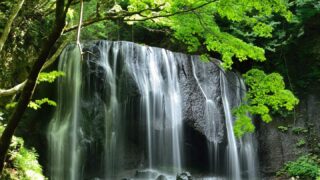
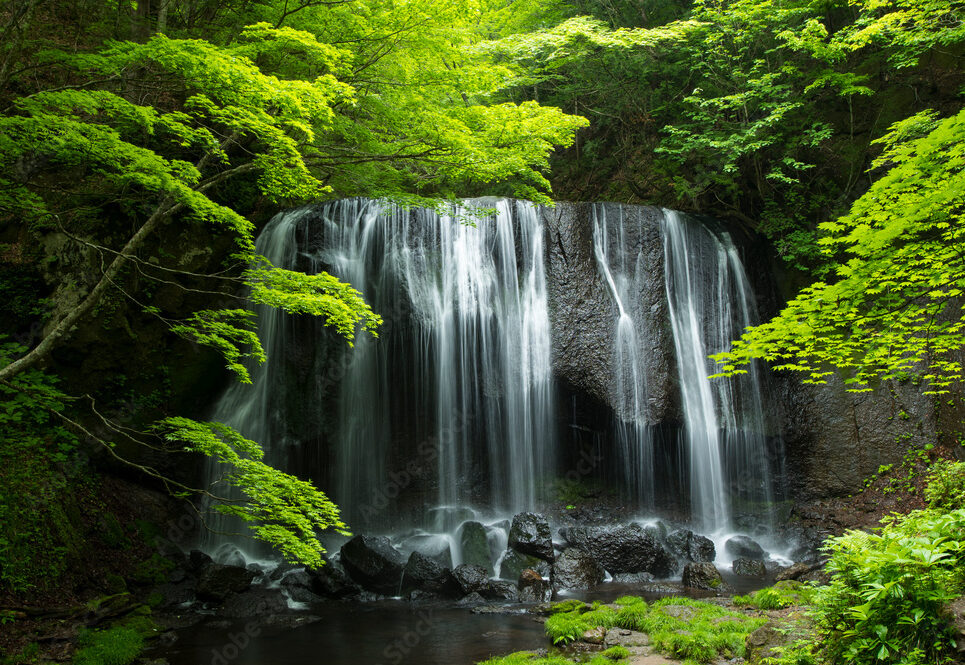
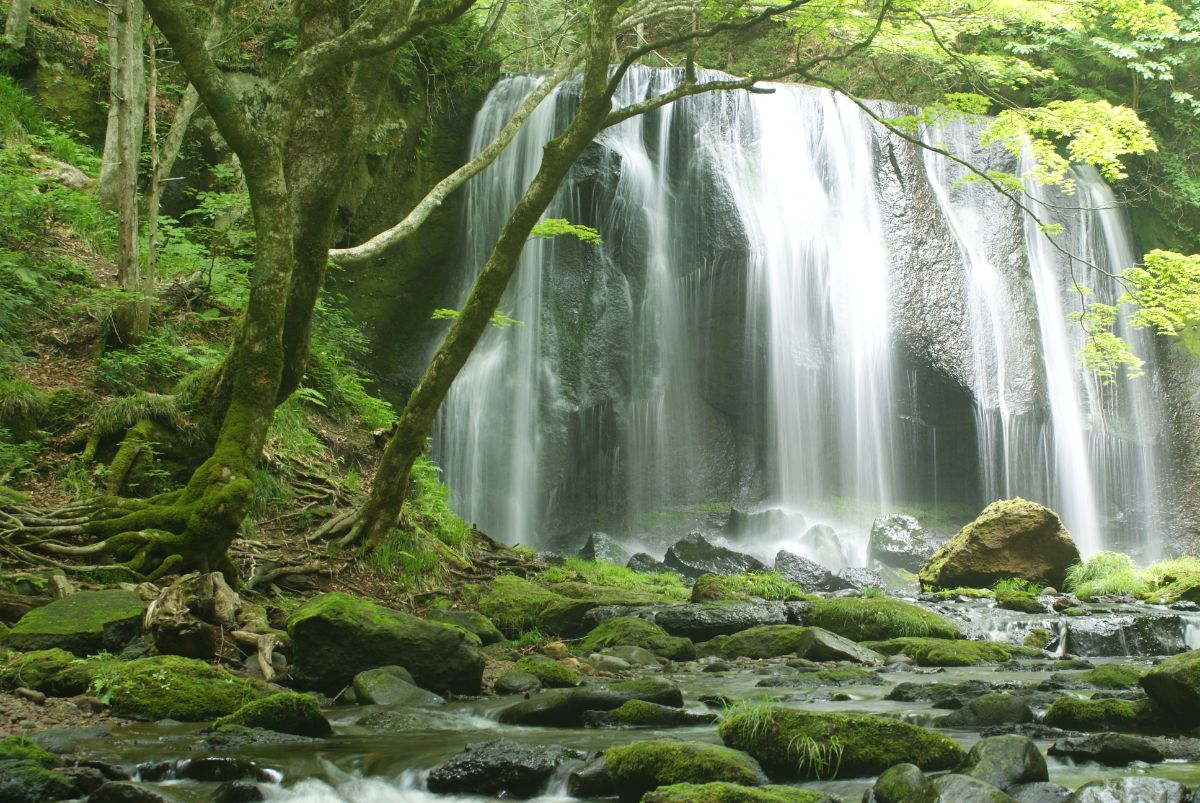
The water from Mt. Funa-Myojin flows in Fudogawa Rive,r and falls down two cascades at Tatsusawa Fudo-daki. One cascade is called Odaki or male waterfall, the mountain water flowing down over the rock surface looks like a reed screen. The other is Medai, or female waterfall. The waterfalls are sacred to Fudo, the God of Fire. Fifteen-minute drive and ten-minute walk from Nakanosawa Onsen hot spa, the waterfalls are very popular. Odaki, with a maple branch sticking out beautifully in front, makes a good subject for photo lovers. You may have seen an image of it in print or on TV.

◆Onogawa Fudo-daki Waterfall
The largest waterfall in Ura-Bandai area. Enjoy the coolness looking up the waterfall cascade which flows 25 meters down the cliff. Without handrails, it looks as though you can walk close to the basin, but the splash and roaring of the waterfall prevent you from approaching. The waterfall is easily accessible by car. Or, it’s within a bike-riding distance from the Lake Onogawa. Turn left at the ‘Waterfall Entrance’ sign about 500meters off the lake, and the unpaved road from this fork leads to the parking lot, the trail head. Pass through the torii arch and walk about 15 minutes in the beech woods, then you will find the waterfall cascade on the left.

◆Maku-daki Waterfall
One of the largest waterfalls in Fukushima-Ken rises in Mt. Takayama on the east end of the Azuma Mountain Range. The powerful waterfall flowing 50 meters down the cliff can be seen from the lookout platform at the bottom of the cascade. Access by car is the most convenient. There is a fork to Makugawa Onsen a little down Tsuchiyu Tohge pass on the old Route 115 for Fukushima. Fifteen-minute drive on a narrow paved road gets you to the secluded hot spring Makugawa Onsen Hot Spring with two inns. About 15〜20 minute walk across several small wooden bridges brings you to the observation platform.

◆Nuno-daki Waterfall
The waterfall is on the way to Deco-daira Shizen Fureai Hodo (Deco-daira nature walking course) from Wasezawa. It is 1.3 kilometers, or 40 minute walk from the parking area. The road runs to Gran Deco and ends there. Azuma-gawa River, rising in Mt. Nishi-Daiten is cascading in tiers here, which is the biggest along the river. The picturesque view of the falling water on the terraced rocks surrounded by woods is overwhelming.

◆Shiraito-no-taki Waterfall
A line of hot spring water spouting out at the former sulfur mine runs down the cliff of the hardened lava which was poured forth from Mt. Adatara. There is no access close to the waterfall cascade, but it is viewed from the observation deck. The deck is a 5 minute walk from the parking area, the trail head to Mt. Adatara, located at the top of Numajiri Ski Area. The best season for viewing the waterfall is autumn. The colored leaves of the trees which ramble over the cliff form a mosaic of red, orange, yellow and green with the white waterfall in the center. Thus, the waterfall is known for autumn leaf viewing.

----------------------------------------------------------------------------------------------------------------
100 Shirominami, Inawashiro-machi, Yama-gun, Fukushima-Ken 969-3192Phone: 0242-62-2117 Fax: 0242-62-5175c/o Inawashiro Town Office, Commerce, Industry,
and Tourism SectionInawashiro Tourism Promotion Planning Committee